libro de los juegos
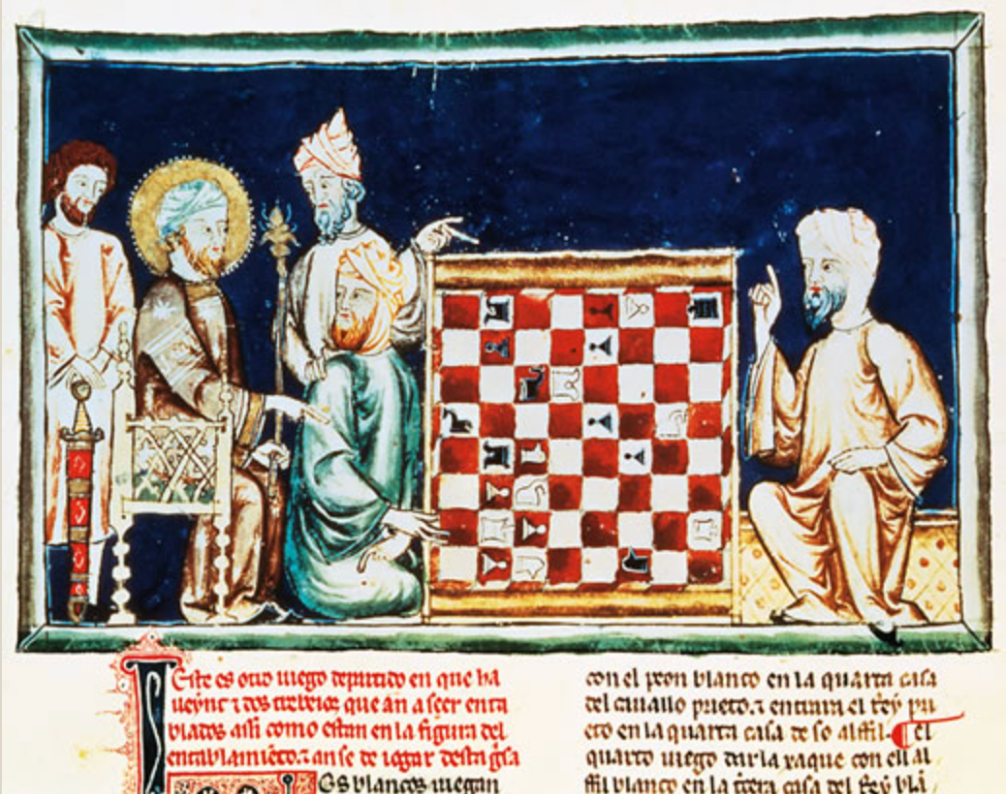
The game of Kings
This object is a page from the 1282 Libro de los Juegos, or Book of Games, created under the rule of Alfonso X of Castile. The image shows two turbaned players seated across from each other at a chessboard. One player appears to be making or considering a move, while the other sits opposite him. The visual focus is the chessboard itself, but the people, clothing, and setting are just as important. The scene shows chess as a social and intellectual activity connected to courtly culture, learned play, and cross-cultural exchange. This page is important for understanding chess across the Silk Road because it represents a western end point of a much larger process of movement. By the time this manuscript was made in 13th-century Spain, chess had already traveled through several cultural zones. The game was shaped by South Asian, Persian, Islamic, North African, and European traditions. The page can be read as evidence that chess in 13th-century Spain was transitioning from styles played in the Middle East and North Africa into what later became modern European chess. That makes the image especially useful because it captures chess during a period of transformation rather than after its rules and visual culture had become standardized. The two turbaned players also matter because they visually connect the game to the Islamic and Mediterranean worlds. Medieval Spain was a place where Christian, Muslim, and Jewish communities interacted in complicated ways. Chess was part of that world of contact. It could move between courts, languages, and religious communities because the game was understandable even when its cultural meaning changed. The image therefore does not simply show two people playing a game. It shows how chess could become a shared cultural practice across political and religious boundaries. Stewart Gordon’s article helps explain the broader history behind this object. Gordon presents chess as a transregional game that spread across Eurasia through trade, diplomacy, and court culture. He emphasizes Persia and Central Asia as major areas in the spread of chess and discusses how piece names and forms changed as the game moved. That larger movement helps explain why a chess manuscript in Spain can still show traces of Middle Eastern and North African influence. As an object, this manuscript page shows that the Silk Road should not be understood only as a single road or as a route for physical goods. It was also a network of cultural transmission. Games, symbols, and habits of elite life moved alongside objects and people. The Libro de los Juegos page shows chess as a cultural bridge between regions. It makes visible the process by which a game from the wider Afro-Eurasian world became part of medieval European intellectual and courtly life.
Bibliography
- Gordon, Stewart. “The Game of Kings.” Saudi Aramco World 60, no. 4 (July/August 2009): 18-23.
- Kruk, Remke. “Of Rukhs and Rooks, Camels and Castles.” Oriens 36 (2001): 288-298.