Brest King
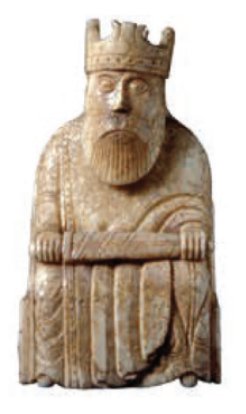
Brest King
The Brest king chess piece is a medieval object discovered in Brest, Belarus, and dated to the 12th or 13th century. It is identified as a depiction of a king, with one example described as fully intact and another related example described as fractured or incomplete. Even though the object is small, it is historically important because it provides material evidence for the spread of chess into medieval eastern Europe. Unlike written sources, which often describe chess as a game of courts and elites, archaeological objects show how the game existed physically in people’s lives. This object matters because chess pieces are not always easy to identify. The article by Dan Băcueț-Crișan, Aurel-Daniel Stănică, and Timea Keresztes focuses on the archaeological materiality of chess in the Middle Ages. Their work argues that some artifacts deserve to be reconsidered as possible chess pieces. This is important because small carved figures may not always be labeled or discovered with a complete chess set. Archaeologists often have to compare them with similar objects from other places in order to understand their function. The Brest king is useful because it gives scholars a point of comparison for identifying other medieval chess pieces. The identification of the piece as a king is also meaningful. In chess, the king is the central figure. The goal of the game is organized around threatening and protecting the king. A king piece therefore carries political symbolism as well as gaming function. In a medieval context, where rulership, hierarchy, and warfare shaped social life, the chess king could represent more than a playing piece. It reflected a world of rank and strategy. As chess moved across regions, those ideas were adapted into local artistic styles and materials. The Brest piece also shows how chess traveled beyond the major centers often associated with the game’s early history. Discussions of chess often focus on India, Persia, the Islamic world, and western Europe. However, an object from Belarus shows that chess also became part of the material culture of eastern Europe. This widens the geography of the Silk Road story. Cultural exchange did not only happen in famous cities or imperial courts. It also reached borderlands, trading towns, and regional communities. As part of this exhibit, the Brest king shows the archaeological side of chess history. The Libro de los Juegos page shows chess in a manuscript, but the Brest king shows chess as a physical object handled by players. It helps prove that the movement of chess was not only literary or symbolic. It left behind material traces that scholars can study today. Through this piece, chess appears as both a game and an artifact of long-distance cultural exchange.
Bibliography
- Băcueț-Crișan, Dan, Aurel-Daniel Stănică, and Timea Keresztes. “Archaeological Materiality of Chess Playing in the Middle Ages: A Few Possible Examples from the Current Territory of Romania.” Ziridava Studia Archaeologica 36 (2022): 1-18.